
More residential trees in this part of North Carolina are ruined by bad pruning than by no pruning at all.
David and the Hamm's Tree Service crew work these trees every week across the Piedmont.
Tree Trimming & Pruning in Durham & the Triangle — Done To The Standard, Never Topped
Five Kinds Of Pruning, Five Different Jobs
Pruning is not one service. Crown cleaning takes out dead, dying, diseased, and rubbing wood and nothing else — it is the safest and most common request, and it is what most mature willow oaks need. Crown thinning selectively removes live branches to let wind pass through the canopy instead of pushing on it, which matters ahead of hurricane season. Crown raising lifts the lower limbs for clearance over a drive or a walkway. Crown reduction shortens the whole canopy using reduction cuts back to a lateral big enough to take over as the new leader. Structural pruning is the one nobody asks for and everybody should: small, cheap cuts on a young red maple or tulip poplar that keep it from growing two competing leaders you will pay to deal with in twenty years.
Topping Is Not Pruning
Cutting a canopy back to stubs is still common around the Triangle and it does three bad things at once. The tree responds by pushing dozens of fast, weakly attached shoots — epicormic growth — from the wounds, so within a few years the crown is denser and heavier than before. Those stub cuts cannot compartmentalize, so decay walks straight down the stems. And the new shoots are anchored only in the outer wood of a decaying stub, which is why topped trees throw limbs in the exact ice storms they were topped to survive. A topped tree is more dangerous at year five than it was the day before it was topped. We will reduce a crown properly. We will not top one.
Where The Cut Goes
Every branch meets the trunk at a slightly swollen collar, and inside that collar is the tissue the tree uses to seal the wound off. Cut just outside it and the tree closes the injury on its own in a season or two. Cut flush to the trunk and you remove the collar along with the branch, leaving a wound the tree cannot close — that is the dark, wet, sunken oval you see on so many older street trees. Leaving a long stub is the other failure: the stub dies, decay enters, and the tree seals around a rotten peg. Big limbs get the three-cut method so the bark does not tear a strip down the trunk when the branch goes.
Timing By Species In The Piedmont
Most hardwoods here prune best in the dormant season, roughly after leaf drop and before spring push — the structure is visible, wounds close fast in spring, and there is no sap-feeding insect traffic. Oaks are the species to be careful with: pruning during the warm active months carries oak wilt risk, so non-urgent oak work belongs in winter. Spring bloomers like dogwood and cherry set their flower buds the previous year, so pruning them in late winter trades away the bloom; wait until just after flowering. Storm-prep thinning is best done in late spring or early summer, well ahead of the late-season stretch when hurricane remnants track inland. Broken, hanging, or hazardous wood comes out whenever it happens, in any month.
Clearance Work Around The House
Limbs dragging on shingles wear the granules off and hold moisture against the roof. Branches over a driveway in Chapel Hill or Hillsborough drop sweetgum balls and pine limbs onto vehicles all year. And the service drop running from the pole to your meter collects branches nobody thinks about until the wind takes the line down. We prune for real clearance — enough that the branch does not reach back in one growing season — while keeping the tree balanced instead of gutting one side of it.
ANSI A300 Is The Yardstick
ANSI A300 is the industry standard that defines how pruning work should be specified and performed in the United States: cut placement, dose limits, the objective for each cut. It is the reason we can tell you before we start what percentage of live crown is coming off and why. If a crew cannot tell you the objective of a cut, the cut does not have one.
What's included
- Crown cleaning — dead, broken, diseased, and crossing wood
- Crown thinning for wind movement through the canopy
- Crown raising for roof, drive, and walkway clearance
- Reduction cuts to a viable lateral (no topping)
- Structural pruning on young and newly planted trees
What to expect
- 1Walk the tree and agree on the objective for each area
- 2Climb and prune from inside the canopy where access allows
- 3Cuts placed at the collar, three-cut method on heavy limbs
- 4Brush chipped, beds checked, drive and walks blown clean
Who this is for
- Mature oaks and poplars that have never been pruned
- Young maples and pears with competing leaders
- Limbs on the roofline, the drive, or the service drop
- Trees previously topped that need corrective work
Tree Trimming & Pruning across the Triangle
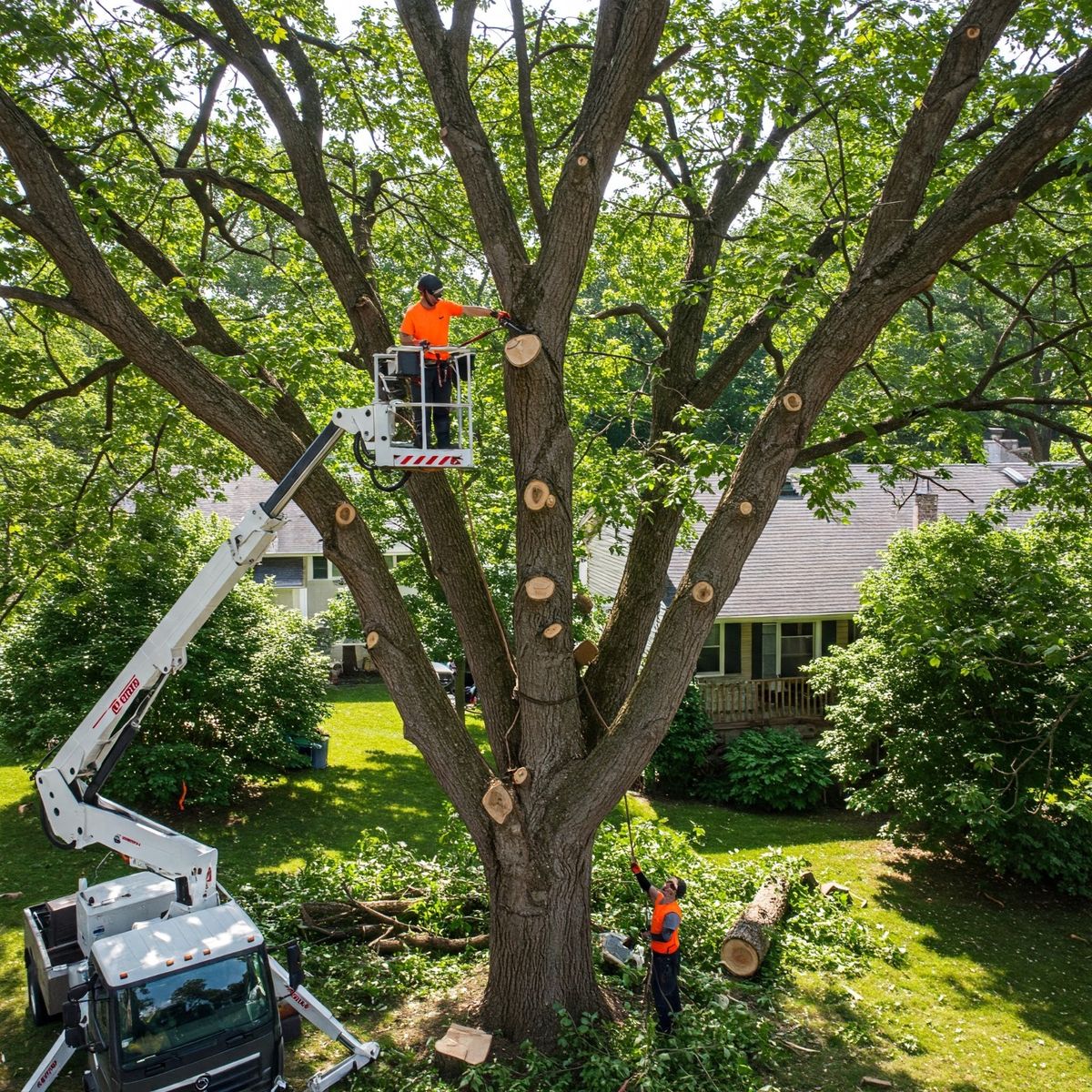
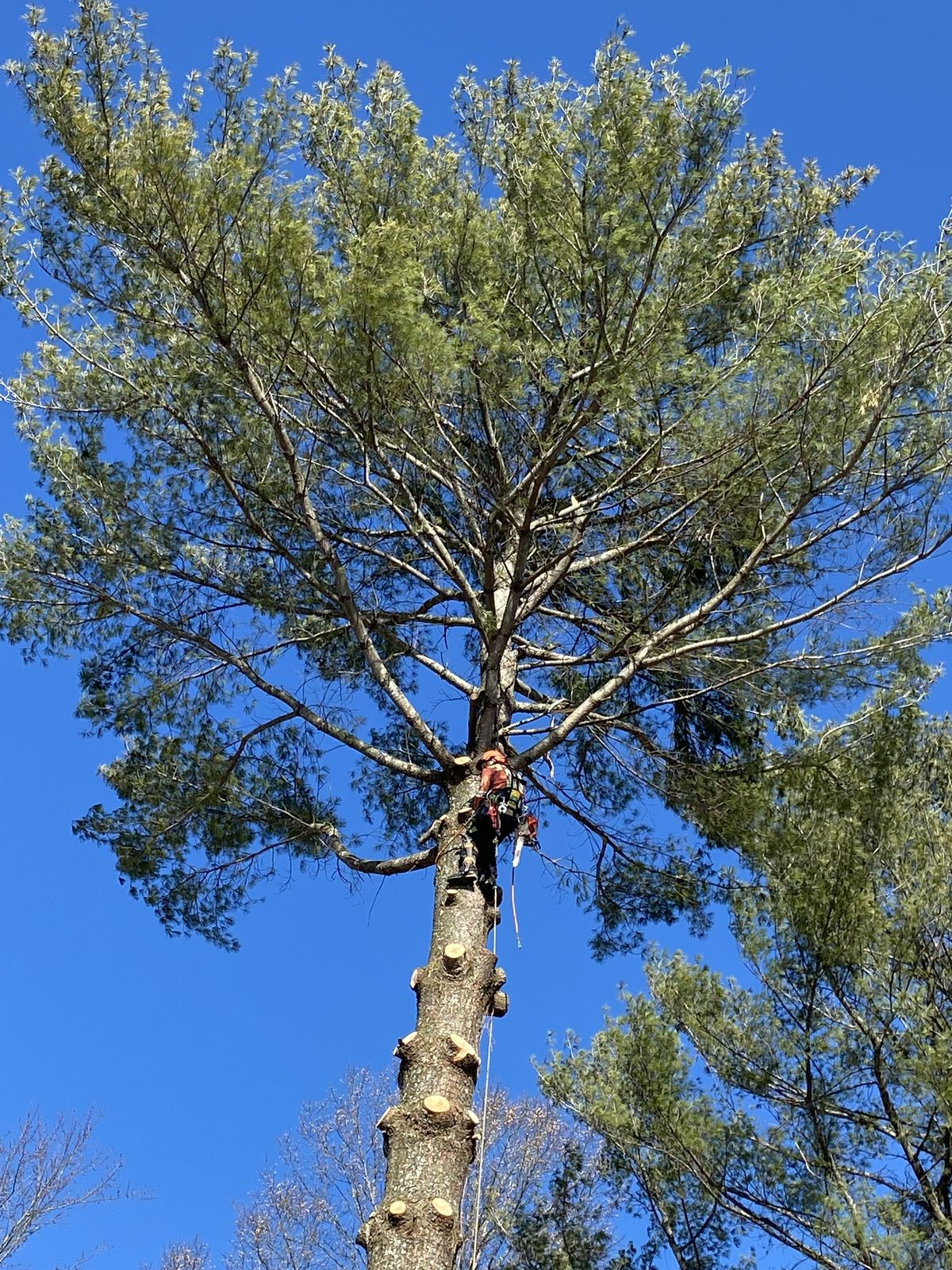
See the work up close.

Pruning Questions, Answered Straight
How often should a mature shade tree be pruned?
Most established hardwoods in a residential yard do fine on a three-to-five year cycle of crown cleaning, with clearance work as needed in between. Young trees benefit from a light structural visit every two or three years while the cuts are still small. Annual heavy pruning is almost always too much.
What is the best month to prune here?
For most hardwoods in central North Carolina, the dormant window from late fall through late winter. Oaks specifically should be kept in that window when the work is not urgent. Spring-flowering ornamentals are the exception — prune those right after they finish blooming.
How much of the canopy can safely come off in one visit?
Less than most people expect. Removing a large share of the live crown at once starves the tree and triggers stress growth, so a mature tree in good health is normally kept well under a quarter of its live foliage in a single season, and less on a stressed or older tree. Deadwood does not count toward that.
There are branches in the power line — will you cut those?
Not the ones touching primary conductors. Line clearance on the utility's own conductors is utility work and belongs to them or their contracted crew, and it is genuinely dangerous for anyone else to touch. The service drop running to your house is a different situation — call us and call the utility, and we will tell you which one of us should be doing it.
My tree leans. Can trimming straighten it out?
No. Pruning changes weight distribution and can reduce sail area on the heavy side, which sometimes helps a marginal tree, but it does not correct a lean and it does not repair a root plate that has moved. If the lean is new, the question is stability, not shape.