

Tree Removal,
Durham NC. Done Right.
Roughly half the trees we get called out to look at don't need to come down. David Hamm will tell you which half yours is standing in — free, on site, before anybody talks price. When it does have to go, 30+ years of climbing gets it down in pieces, on ropes, without a mark on the roof.
Price My Tree Removal
Send the details — David gets back to you, usually the same day.
Six Signs A Tree Has Crossed The Line
Walk your yard with this list before you call anybody. If none of it describes your tree, pruning is probably the answer and we will say so.
A lean that changed
Crooked since it was young is normal. New lean with cracked or mounded soil on the high side means roots are already letting go.
Conks at the base
Shelf fungus, mushrooms in the root flare, or a hollow drum when you tap the trunk all point to decay working through the stem.
A hanging leader
A leader split in a summer downburst and still holding on a hinge of wood is not stable. It is waiting on the next gust.
Roots cut by digging
A trench, driveway pour, or grading job on one side shows up years later as slow decline and then a windy-day failure.
Bark falling in sheets
Loose plates of bark and big deadwood high in the crown mean the tree is shedding structure, not just leaves.
Dead over something you use
A dead pine deep in the woods can stand for years. Forty feet from a bedroom, it is on a clock — pines come over at the base.
The Three Trees That Keep Our Phone Ringing
Water oaks
Fast, big, and hollowing out from the inside somewhere in their sixth or seventh decade — exactly the age of the water oaks planted across older Durham and Roxboro neighborhoods. They hold a full green canopy right up until a limb the size of a small tree lands in the driveway.
Bradford pears
Every branch leaves the trunk at the same point and the same tight angle, so the whole crown is one included-bark split waiting on an ice load. Over a parking pad, a Bradford pear is worth planning for instead of reacting to.
Loblolly pines
Shallow-rooted, eighty feet tall, and planted in rows close to houses across the Triangle. Once beetles or root decay get in, a pine does not shed limbs first — it comes over at the base, whole.
From First Look To Raked Yard
David walks the tree with you
Free, on site, no pressure. He tells you if it can be saved with pruning instead — roughly half the trees we get called about can be. You get the honest verdict either way.
Written scope and firm price
What comes down, what stays, where the wood ends up, whether the stump goes. Insurance certificates and permit questions handled before the date is set.
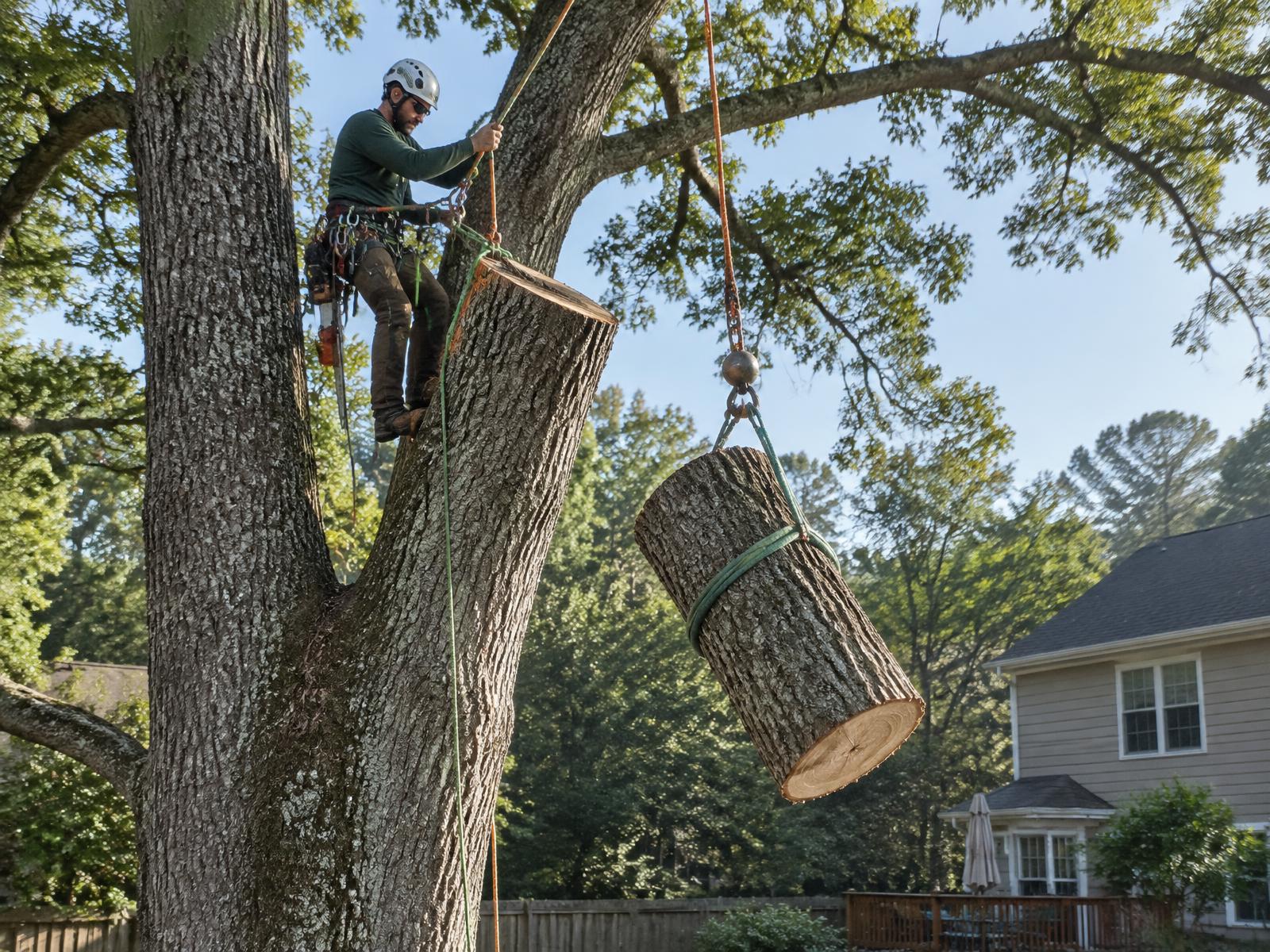
Take-down the way the site allows
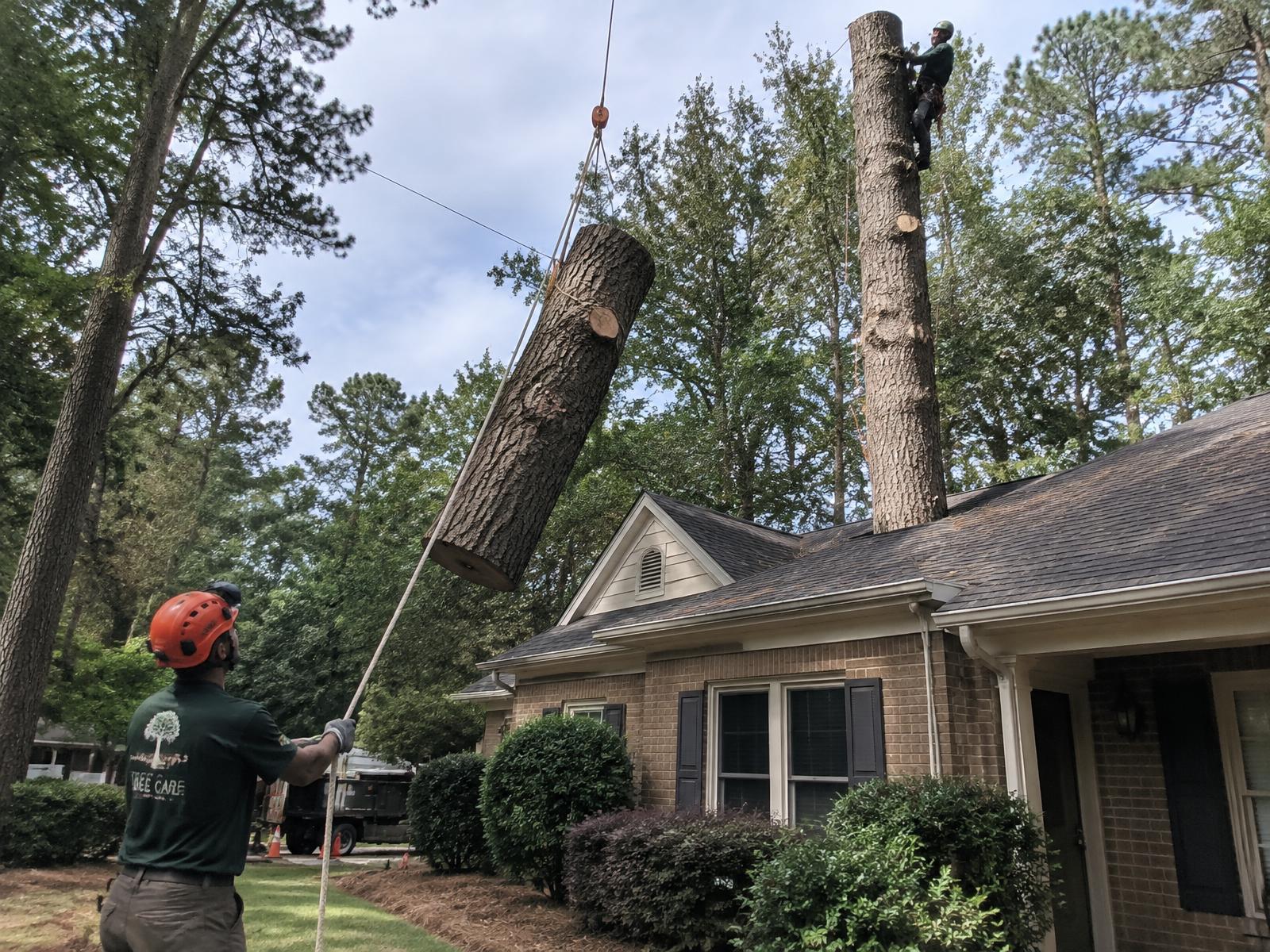
Open drop zone and it comes down in one piece. Tight lot, fence, roof, or service drop and it goes in sections on ropes, or with a crane when the wood is too heavy to hand-rig.
Clean yard before we leave
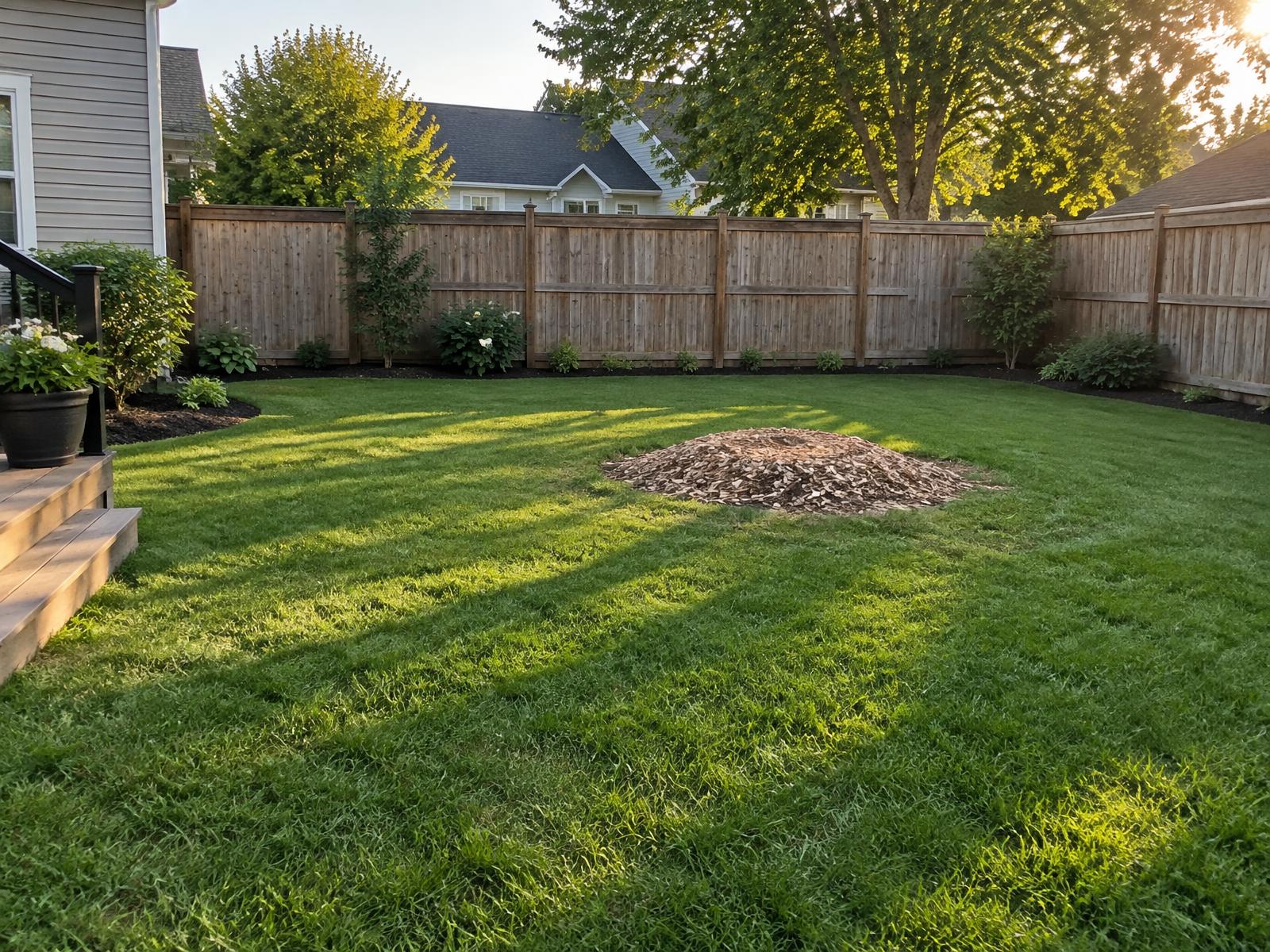
Brush chipped, wood placed or hauled, hardscape blown clean, grade raked. If you had the stump ground, chips mound over the hole and settle in a few weeks.
Every Removal Includes
- On-site assessment before any number is given
- Sectional dismantling, open drop, or crane assist
- Rigging over roofs, decks, fences, pools, and beds
- Ground protection and mats on soft or wet clay
- Brush chipped, trunk wood hauled or cut to length
- Full clean-up: drive blown, grade raked
- Insurance certificates sent before the job
- Optional stump grinding quoted separately
Six Things That Move The Number
Nobody can price a removal off a phone description, and a quote given that way is a guess you end up paying for. Here is what David is actually measuring when he walks your tree.
Height and trunk diameter
A sixty-foot pine and a ninety-foot oak are different days of work, different rigging, and different wood volume to move.
What sits underneath
Fence eight feet off the trunk, a screened porch, a pool, or a bed of mature landscaping means everything is lowered instead of dropped.
How close we can park
Chipper at the base is fast. Chipper on the street with a narrow gate means brush and wood get carried by hand.
Power lines
Clearance around a service drop is our work. Anything contacting a primary conductor is the utility's first — we coordinate, we don't guess.
Where the wood goes
Hauled off, cut to firewood length and stacked, or left in rounds. Each option prices differently.
Stump or no stump
Grinding is a separate line so you can see it and choose. Full root-ball excavation is available when you are replanting.
Permits, Right-Of-Way, And Property Lines
For a tree standing entirely on private residential property in Durham County or the City of Durham, a permit generally is not required — the City's urban forestry guidance treats private trees as the owner's responsibility.
The exception catches people every year: a tree in the public right-of-way or a City-owned tree cannot be removed without City approval first under Durham Code §26-227, and the strip between the sidewalk and the property line often falls in that category. Don't assume a street-side tree is yours. Durham Urban Forestry will confirm ownership at 919-560-4197.
Larger clearing that disturbs more than 12,000 sq. ft. requires a Durham County land-disturbing permit. New developments, commercial sites, and designated preservation areas carry their own tree-coverage and buffer rules.
If the tree is on a neighbor's side and hangs over your yard, start with a conversation — most of these get settled in one. Overhanging limbs and shared trees are a legal question rather than an arborist one, so get North Carolina-specific advice before anyone cuts. We won't work on a tree without permission from the person who owns it.
Already down or on the house?
Weight resting on a roof works its way through decking and flashing, and a hung-up limb can release without warning. That is emergency work, not a scheduled removal — call, don't wait on a form.
(919) 641-3064Emergency tree removalTree Removal Across The Triangle & Lake Country
Based out of Rougemont, running daily into Durham and Orange County, north to Roxboro, and east toward Kerr Lake and Lake Gaston.
Tree Removal Questions We Get Weekly
How much does tree removal cost in Durham?
Price follows the work, not a menu. The four things that move it are height and trunk diameter, what sits underneath the tree, how close we can park the chipper and truck, and whether the wood and stump leave with us. A pine standing alone in an open side yard is straightforward. That same pine ten feet off a brick corner, behind a gate too narrow for equipment, is a rigging job where every piece is lowered by hand. David gives you a firm number on site after he has walked the tree — never a phone guess you end up paying for.
Do I need a permit to remove a tree in Durham County?
For a tree standing entirely on private residential property, a permit generally is not required — the City treats private trees as the owner's responsibility. Two exceptions matter. A tree in the public right-of-way or a City-owned tree cannot be touched without City approval (Durham Code §26-227), and the strip between the sidewalk and the property line often falls there. Clearing that disturbs more than 12,000 sq. ft. needs a Durham County land-disturbing permit. If ownership is unclear, Durham Urban Forestry at 919-560-4197 will confirm it, and we verify before a saw comes off the truck.
Can you take a tree down over my house without damaging the roof?
Yes — that is most of what we do. Nothing goes into free fall above a structure. A climber works up the stem, limbs come off on ropes, and the trunk is taken in short pieces controlled through a lowering device so the weight is always on the rope instead of the shingles. Where the drop zone is impossible or the wood is too heavy to hand-rig, we bring a crane. We also lay protection over walks, beds, and septic lids first.
How soon can you get here?
Scheduled removals are typically booking one to two weeks out, and David usually returns quote requests the same day. If a tree is already down, resting on the roof, or hung up over something you use, that is emergency work — call rather than fill out a form. Someone answers the phone 24 hours a day, including through hurricane and ice-storm weeks.
What happens to the wood and the brush?
Your call, decided before we start. Brush gets chipped on site. Trunk wood can be hauled away, cut to firewood length and stacked where you want it, or left in rounds if you split your own. Hardwood we haul out becomes seasoned firewood we deliver back within about fifteen miles of Durham.
Is the stump included in the removal price?
No, and that is on purpose. Grinding is quoted as its own line so you can see the cost and decide. Some people want it gone the same day, some are fine leaving a low-cut stump, and some are replanting and need the root mass excavated instead of ground — all three are options.
Are you insured, and will you send proof?
Fully insured, and we send certificates to homeowners, HOAs, and property managers before the job without being chased for them. Ask and it is in your inbox the same day.
Will heavy equipment tear up my yard?
Piedmont red clay does not forgive machinery when it is soaked, so we time the work and lay mats where we need traction. Expect the debris gone, the drive and walks blown clean, and the grade raked before we pull out. If something does get marked up, you hear it from us before you find it.
Get A Free Look At The Tree — Then Decide
David Hamm answers the phone himself. Call him or submit the quote form to have him walk the yard with you. If it can stay, he'll tell you that.