
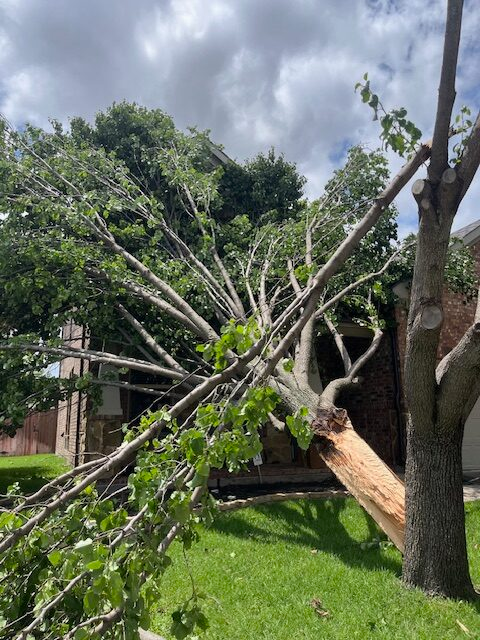
24-Hour Emergency Tree Removal in Durham & the Triangle
If a tree is on your house or hanging over people, stop reading in a minute and call (919) 641-3064. The rest of this page is triage.
The First Ten Minutes
Move everyone out from under it and out of the rooms beneath it. Do not walk under a hanging limb to get a better photo. If any part of the tree is touching a power line, or a line is down anywhere near it, assume every wire and every wet surface around it is live: stay back, keep pets and kids inside, and call the utility before you call anyone else. If someone is hurt, or a wall, roof, or ceiling has collapsed, that is 911 first. Once people are clear and the utility is notified, call us and describe what is touching what. That one sentence tells us what truck and what gear to bring.
What Counts As An Emergency
A tree or large limb on the house, garage, or a vehicle. A trunk across the only way in or out. A split trunk or a hanging limb suspended over a driveway, deck, play area, or a room in use. A root plate visibly lifted out of the ground with the tree still standing — that one is more urgent than it looks, because the tree is being held by nothing but the remaining roots and its own balance. Anything blocking a road or contacting a line, once the utility has been called. Those are the ones you call about at 2 a.m.
What Can Wait Until Business Hours
A tree down in the back of the lot, away from structures and away from where people walk. Brush and limbs on the lawn. A leaning tree that has leaned the same way for ten years. A trunk across a fence line, once you have confirmed nothing above it is still hung up. Waiting on these is not neglect — it is how you keep the emergency response available for the neighbor with a pine through their bedroom ceiling, and it usually costs you less than a night call.
Why A Hung-Up Tree Is The Dangerous One
A tree flat on the ground has spent its energy. A tree that came partway over and stopped — caught in a neighboring canopy, resting on a fence, split and hinged on a strip of fiber — is a loaded spring. The wood is under compression on one face and tension on the other, and those forces are not where they would be on a standing tree. Cut in the wrong place and the stem snaps shut, kicks sideways, rolls, or drops the whole load at once. This is how homeowners with a chainsaw and good intentions get hurt every single storm season in North Carolina. If it is hung up, leaning on something, or split and still standing, leave it and let someone with rigging and a plan take it apart.
Document Before Anything Moves
Insurance adjusters work from evidence, and evidence disappears the moment cleanup starts. Before we cut, take photos from several angles: wide shots showing the tree and the structure together, close shots of the point of impact, the interior damage, and anything wet or exposed. Get the date and time in the file data. Photograph the base of the tree and the root plate too, since carriers often ask what failed and why. Save receipts for tarps or anything you buy to stop further damage. We take our own photo log on emergency calls and will send you the file.
Working A Job At Night Or In Weather
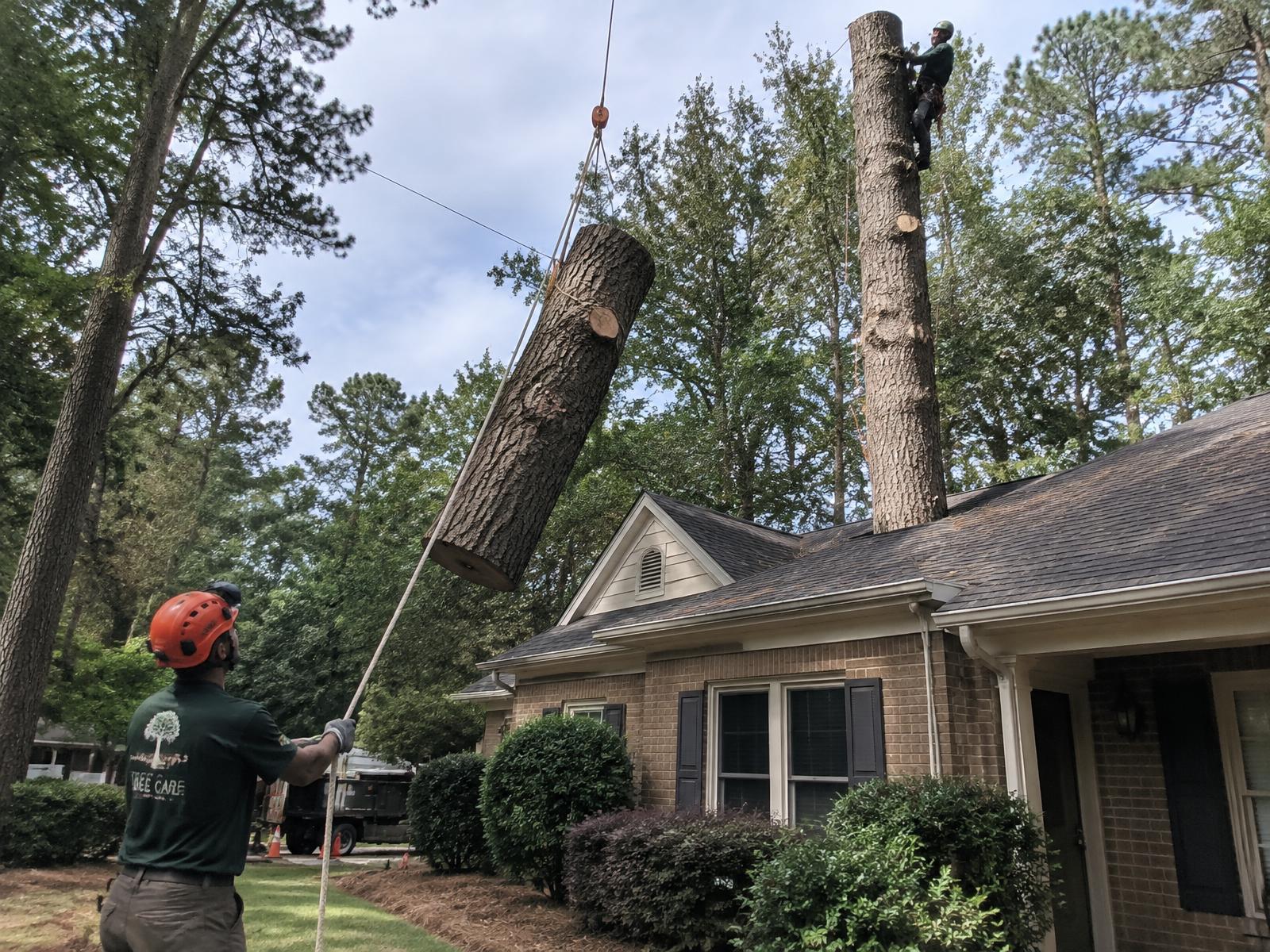
Night work and wet work are slower on purpose. We light the zone before anyone touches a saw, expand the exclusion area because visibility is short, and lean toward mechanical advantage and rigging instead of climbing a wet, wind-loaded stem. The first objective on a bad-weather call is not a clean yard — it is making the property safe: get the load off the structure, tarp what is open to the sky, clear the exit, and stabilize what is still standing. Full cleanup is a daylight job, and we come back for it.
This Page Is Not Storm Cleanup
If the danger has passed and what you are left with is a yard full of limbs, a fallen trunk, and trees you are not sure about anymore, that is aftermath work rather than an emergency call.
What's included
- 24-hour phone line for active hazards
- Make-safe first: load off the structure, exits cleared
- Rigged dismantling of hung-up, split, and uprooted trees
- Tarping of openings where we can do it safely
- Photo log and written scope for your claim
Who this is for
- Tree or limb resting on a house, garage, or vehicle
- Split trunk or hanging limb over an occupied area
- Root plate lifted with the tree still standing
- Trunk blocking the only access to the property
What to expect
- 1Tell us what is touching what — that sets the response
- 2Utility and 911 first if lines or injuries are involved
- 3Crew arrives, sets an exclusion zone, and makes it safe
- 4Documentation sent, full cleanup scheduled in daylight
Emergency Tree Removal across the Triangle
See the work up close.

Emergency Questions People Ask At 2 A.M.
Will my homeowner's insurance pay for this?
Coverage commonly turns on whether the tree damaged a covered structure, and policies differ a great deal on limits and on trees that fell without hitting anything. We cannot tell you what your policy does — call your carrier's claims line, which is staffed around the clock, and get a claim number started while we work. We will give you documentation either way.
It came from my neighbor's yard. Does that change who pays?
Usually less than people expect. Claims like this are typically handled by the policy covering the property that was damaged, and fault only enters the picture in specific circumstances. That is a conversation for your carrier, not for us. In the meantime, we need the property owner's permission before working on their tree.
There is a tree on the power line. Who is responsible for that?
The utility, and only the utility, on their conductors. Call them first and do not wait for us — nobody in our trade should be cutting a tree in contact with an energized line. Once the utility has de-energized or cleared their side, we can take care of the rest of the tree.
A tree hit the roof. Is it safe to stay in the house?
Stay out of the affected rooms and the floors below them at minimum. If there is any sag in a ceiling, cracking in a wall, a shifted door frame, or you smell gas, get out entirely and call 911. Nobody on a phone can certify your structure — that call belongs to the fire department or a building official.
What should I be doing while we wait for the crew?
Keep everyone away from under the tree and out of the drip line of anything still leaning. Move vehicles if you can do it without passing under the hazard. Shut off power to a damaged area at the breaker if that is safe and you know which one it is. Take your photos from a safe distance. Then leave it alone.